INVOICES AND E-INVOICING
Automate invoice processing: steps, limits and what e-invoicing rules require
Monday morning, and there are 40 new invoices in the inbox: PDFs from wholesalers, a few scans and an XML file nobody can really open. Someone types in supplier, amount and date, puts the documents out for approval and hopes nothing gets paid twice and no changed bank details slip through. If you want to automate invoice processing, this pile is where you start.
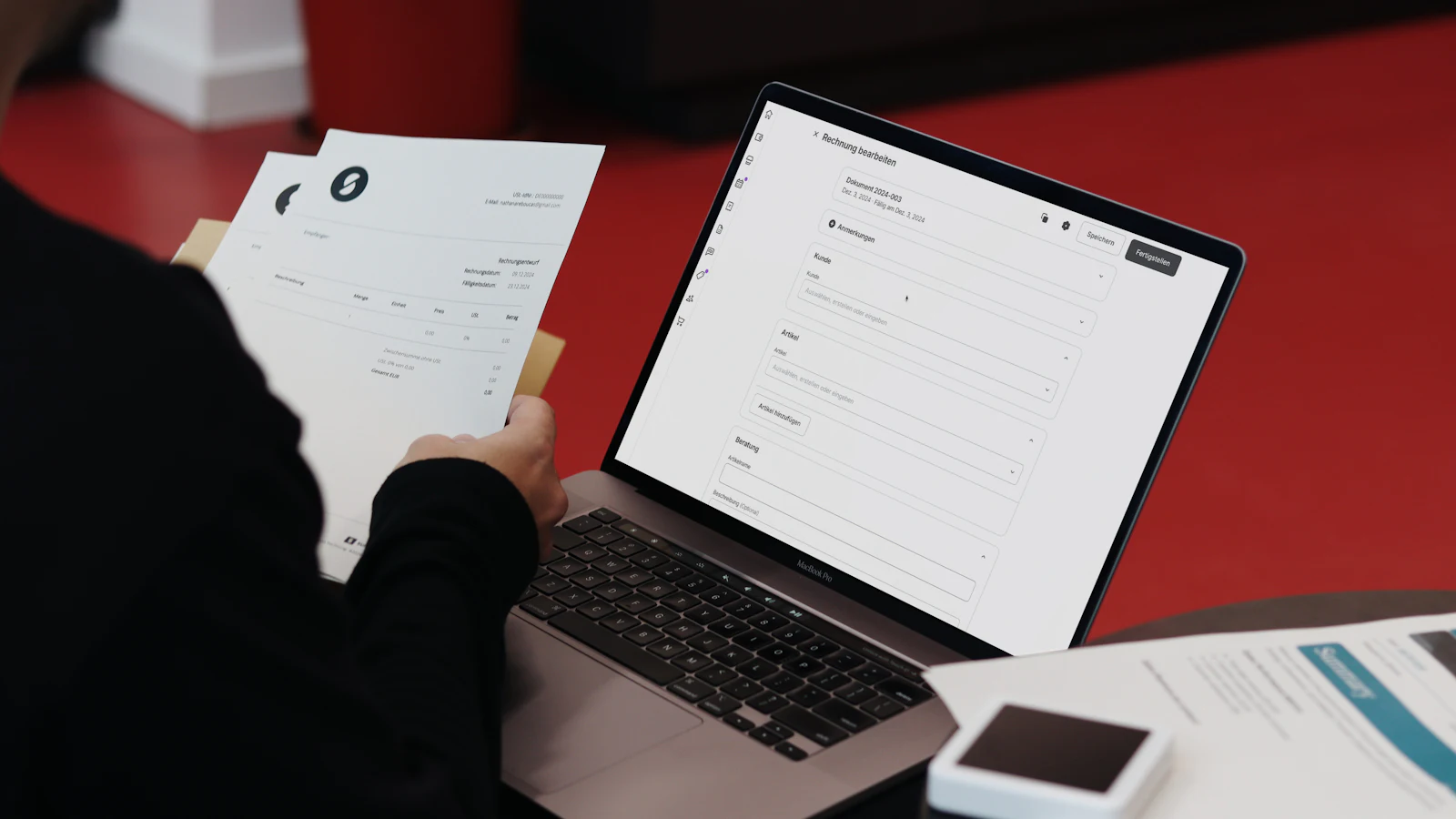
The pile costs hours, and it costs oversight. A typo in an amount or an invoice recorded twice sometimes only surfaces at the year end close. When the one colleague who knows the process is on holiday, everything waits. At the same time, e-invoicing is changing the rules in Germany, and many businesses in Austria wonder what applies to them.
This article walks through the six steps of incoming invoice processing, which of them can be automated reliably, where a person has to decide and which e-invoicing rules apply as of November 2026, separately for Germany and Austria.
Quick answer: what can you automate in invoice processing?
Automating invoice processing means software takes over the recurring steps from receipt to handover to accounting. People only review exceptions and approve. Your team stays in charge of the process and decides, it just types and searches less. Almost every business follows the same six steps.
- Receive
Invoices arrive in one fixed place, for example a dedicated mailbox. Paper is scanned on arrival.
- Extract
Supplier, invoice number, date, amounts and VAT rates are read from the file, directly from the XML or from PDFs and scans using text recognition.
- Check
Mandatory details present, totals add up, invoice not already recorded, bank details unchanged.
- Match
The invoice is matched to a purchase order, delivery note, cost centre or project.
- Approve
An authorised person confirms that the goods or service and the amount are correct.
- Hand over and archive
Data goes to accounting, the file goes to the archive and the payment is prepared.
| Step | Automates well | Stays with a person |
|---|---|---|
| Receive | Collect mailbox, file attachments, detect duplicates | Opening and scanning paper mail |
| Extract | XRechnung and ZUGFeRD almost fully, PDF well, scans with limits | Illegible or unclear documents |
| Check | Arithmetic, mandatory fields, duplicates, flag changed IBAN | Whether the service is actually correct |
| Match | Matching by PO number and supplier master data | Coding without a clear rule |
| Approve | Routing to the right person | The approval itself |
| Hand over | Import file, archive, payment proposal | Releasing the payment |
E-invoicing in 2026: what applies in Germany and Austria?
This reflects the rules as of November 2026. The two countries differ a lot. Please check the details for your business with your tax adviser.
Germany: receiving is mandatory, sending follows by 2028
- Receiving: Since 1 January 2025, all businesses established in Germany must be able to receive e-invoices, including small businesses under the VAT exemption scheme. An email inbox is enough, and you do not need a separate inbox just for e-invoices.
- What counts as an e-invoice: an invoice in a structured format based on the European standard EN 16931, such as XRechnung (a pure XML file) or ZUGFeRD from version 2.0.1 (a PDF with an embedded XML file, excluding the MINIMUM and BASIC-WL profiles). A plain PDF invoice legally counts as an other invoice (section 14 of the German VAT Act), even when it arrives by email.
- Sending: In 2025 and 2026 all businesses may still issue other invoices: paper at any time, PDF only with the recipient's consent. In 2027 this only applies to businesses with total prior year turnover of no more than €800,000, and EDI, a direct data exchange between both companies' systems, remains possible with the recipient's consent. From 1 January 2028, all businesses must issue e-invoices for domestic B2B sales (section 27(38) of the German VAT Act). As of November 2026, no postponement has been decided. If you have to send e-invoices yourself, you can convert a PDF invoice in the free e-invoice creator.
- Exceptions: Small invoices up to €250 gross, travel tickets and invoices from small businesses under the VAT exemption scheme may always be other invoices. If either party is not established in Germany, the obligation does not apply.
- Retention: eight years from the end of the year of issue (section 14b of the German VAT Act, and section 147 of the Fiscal Code for accounting records), down from ten since 2025 (Fourth Bureaucracy Relief Act). For e-invoices, the structured part counts and must be kept unaltered in its original format. Under the GoBD bookkeeping rules since July 2025, you only need the PDF part of a ZUGFeRD invoice if it contains different or additional tax relevant information.
- New in October 2026: A third letter from the Federal Ministry of Finance dated 15 October 2026 adds details on advance invoices, construction services, gross prices and corrections. The transition periods stay the same. It also makes clear that issuing an other invoice where an e-invoice is required is not an administrative offence under section 26a of the VAT Act.
Austria: no general mandate, but required for federal government
- Between businesses: As of November 2026 there is no general obligation to use structured e-invoices, and we are not aware of a draft law.
- Electronic invoices: Under section 11(2) of the Austrian VAT Act, a PDF invoice counts as an invoice if the recipient agrees. Authenticity of origin, integrity of content and legibility must be ensured for seven years.
- Invoices to the federal government: Since 1 January 2014 they must be submitted in structured form (section 5 of the ICT Consolidation Act), via the business service portal (USP) or the Peppol network, in formats such as ebInterface or UBL. According to the USP, this obligation does not currently apply to invoices to the federal states (Länder) or municipalities.
- Outlook: The EU's ViDA directive (2025/516) requires structured e-invoices for cross border B2B transactions within the EU from 1 July 2030. Since 14 April 2025, member states may also require them domestically without asking the EU for an exemption. Whether and when Austria will do so is open.
For Austrian businesses this means most invoices will stay PDF for now. A survey by WKÖ, the Austrian Economic Chamber, and AUSTRIAPRO in March 2025 found that 58.3% of respondents prefer PDF invoices and only 16% capture invoices automatically. If you buy from German suppliers, though, you will receive more XRechnung and ZUGFeRD files and need both: reliable PDF capture and a clean route for XML files.
| Topic | Germany | Austria |
|---|---|---|
| Obligation to receive | Since 1 Jan 2025 for all domestic businesses | No general obligation |
| Obligation to send (B2B) | 2027 above €800,000 prior year turnover, from 1 Jan 2028 for everyone | None domestically, cross border within the EU from 1 Jul 2030 (ViDA) |
| Is a PDF an e-invoice? | No, it is an other invoice | Electronic invoice with consent, but not structured |
| Common formats | XRechnung, ZUGFeRD | PDF, ebInterface and Peppol UBL for government |
| Retention | 8 years (section 14b VAT Act), structured part in original form | 7 years (section 132 BAO), longer in special cases |
How do you automate incoming invoices? Step by step
1. Bundle the inbox
As long as invoices land in five personal inboxes, no software can work reliably. Set up an address such as invoices@yourcompany.com and give it to every supplier. Scan paper on the day it arrives and put it in the same folder. The gain: every invoice is in one place, even when someone is ill or on holiday.
2. Check what your software already does
DATEV (mainly in Germany), BMD (mainly in Austria) and many ERP systems offer their own features for document intake and e-invoices, depending on version and package. Ask your vendor or tax adviser before buying a new tool. Often only one step is missing, such as matching against the purchase order.
3. Read XRechnung and ZUGFeRD directly
With XRechnung and ZUGFeRD, all data is already in the XML. Software takes it over without text recognition, so there are no reading errors. Anything the supplier entered wrongly is still wrong in the XML, though. So check the file with a validator, a program that tests the format. In Germany, the finance ministry considers it sensible to keep the validation report as evidence. It also makes clear that the technical check does not replace your own review of the invoice content. To read a single file quickly, drop it into our free e-invoice viewer. It shows XRechnung, ZUGFeRD and PEPPOL as well as the Austrian ebInterface format like a paper invoice, recalculates totals and VAT and checks the IBAN check digits, without uploading anything. It does not replace a full validation against every rule of the standard.
4. Extract PDFs and scans with checks
PDFs and paper need OCR (optical character recognition), software that recognises letters in an image. AI based recognition usually copes better with differently laid out invoices than fixed templates do. Errors are still possible, more often with scans than with digitally created PDFs. Define which fields go to review when the result is uncertain, rather than letting the system guess. That way you see at a glance where to look instead of rechecking every invoice in full.
5. Define your checks
- Net plus VAT equals gross, and the VAT rate fits the goods or service.
- Supplier and invoice number do not exist yet, otherwise it is a duplicate.
- VAT ID and bank details match the supplier master data.
- PO number present and amount within the agreed tolerance, the basis of a two or three way match.
6. Approval, handover and archive
Set amount limits: below a threshold one approval is enough, above it two people check. Then the data goes to accounting as an import. In Germany, archive the structured part of an e-invoice unaltered in its original form for eight years. In Austria the general retention period is seven years. Choose storage where you can find any invoice quickly, including during a tax audit.
Example: 250 incoming invoices a month
| Invoice type | Share | Route | Review effort |
|---|---|---|---|
| ZUGFeRD or XRechnung | about 40% | Take over XML directly, validate | Low, only on deviations |
| PDF by email | about 50% | Extract with OCR and checks | Medium, review uncertain fields |
| Paper | about 10% | Scan, then as PDF | Higher, more reading errors |
The trades example shows similar workflows. In Austria the PDF share would usually be much higher today, because structured invoices between businesses are still rare.
Where are the limits of invoice automation?
- Whether the work was done: The fitter or the buyer knows that, not the software.
- Coding without a clear rule: If the same supplier invoice is sometimes materials and sometimes tools, someone has to decide.
- Special cases: Partial invoices, credit notes, corrections and invoices covering several orders.
- Approval and payment: Both should always stay with an authorised person.
- Very small volumes: With 20 to 30 invoices a month, the document intake of your accounting software is often enough.
And what does it cost to change nothing? A cautious calculation: 250 invoices a month at 4 minutes each for typing and filing is almost 17 hours a month, or 200 hours a year. At an assumed €38 per hour including employer costs, that is around €630 a month or €7,600 a year. Then there are costs no hourly rate captures: an invoice paid twice, a missed early payment discount, a payment to the wrong account. Run your own numbers in the office work cost calculator, and subtract the review time that remains after automation.
Common mistakes when digitising incoming invoices
- Keeping only the PDF: In Germany, what counts for an e-invoice is the structured part. It must be archived in its original form, a printout or image is not enough.
- Filing XML files unread: An XRechnung is hard for people to read without a viewer. Decide which program you use to open it, such as your accounting software or the e-invoice viewer.
- Accepting extracted values unchecked: OCR confuses characters. Uncertain fields belong on a review list.
- Clarifying exceptions by email: Questions get lost in inboxes. Keep a list with a status.
- Starting with the tool: Describe the process and rules first, then choose the software.
When does an office helper for invoice intake make sense?
Many businesses manage well with the document intake of their accounting software. A gap often remains where invoices come from different sources, need to be checked against orders in the ERP, or have to be converted into a specific import format.
That gap is what an office helper closes. It extracts invoices, applies your checks and prepares the data for your accounting. Your existing software stays. Unclear documents are flagged for your team, and approval and payment stay with you. See how it works on capturing incoming invoices automatically. If your main problem is typing the same data into email, Excel and accounting, read how to enter each invoice only once.
How much of this your accounting software's document intake already covers, and where an office helper would close the gap, is what the free workflow check clarifies. Tell us how your invoices arrive today and who checks them. Within 1–2 working days you get a personal, free assessment. If an office helper fits, you then get a fixed price from €1,990 excl. VAT, and small projects are in place 3–7 days after the use case is agreed.
Sources and further reading
- BMF: Fragen und Antworten zur Einführung der obligatorischen E-Rechnung
- BMF-Schreiben vom 15. Oktober 2025: Einführung der obligatorischen elektronischen Rechnung
- BMF-Schreiben vom 15. Oktober 2026: Ergänzende Regelungen zur E-Rechnung
- § 27 UStG (Deutschland): Übergangsregeln zur E-Rechnung in Absatz 38
- § 14b UStG (Deutschland): Aufbewahrung von Rechnungen